If you read anything about the RV market last year, you probably came away thinking used rigs were about to get scarce and valuable. That was the story in 2025. It is not the story now.
Halfway through 2026, the numbers have gone the other direction — and they have gone there fast. Wholesale shipments are down double digits every single month. The industry’s own forecast got cut by roughly 35,000 units in a single quarter. And Black Book, which tracks what dealers actually pay at auction, has used values easing across nearly every category.
For an owner sitting on a rig they are not using, that combination matters more than any headline. A softening market plus Southern California storage rates means the cost of waiting is real, measurable, and compounding. Here is what the data says, what it means for your specific type of RV, and how to move if you decide the math is not working in your favor.
What the 2026 Numbers Actually Show
Shipments have declined every month this year
The RV Industry Association surveys manufacturers monthly, and 2026 has been a steady drumbeat of declines. June 2026 came in at 25,484 units, down 13.1% from the 29,332 shipped in June 2025. Through the first six months, the industry moved 163,644 RVs against 190,705 over the same stretch last year — a 14.2% drop.
May was worse. Shipments fell to 22,900 units, an 18.7% year-over-year decline. March was down 13.9%, April down 17.4%.
Towables are absorbing most of the damage. June towable shipments fell 14.3%, with travel trailers leading the decline. Motorhomes have held up noticeably better — down just 1.6% in June, and actually up in several earlier months this year. Park models are the one genuine bright spot, running about 24% ahead of last year.
The forecast got revised down hard
This is the detail most coverage skips, and it is the most telling one.
Back in the spring, the RVIA’s quarterly RoadSigns forecast projected 2026 shipments in the 328,800–367,000 range, with a median around 349,000. That would have been a third straight growth year on top of the 342,220 units shipped in 2025.
By summer, that forecast was cut to a range of 300,000–328,100 units with a median of 314,000 — an 8.2% decrease from 2025. RVIA president Craig Kirby pointed to higher financing costs, tighter household budgets, and consumers pushing off discretionary purchases.
A forecast moving 35,000 units in one quarter is not noise. It is the industry recalibrating to demand that did not show up.
Used values are following
Shipment data tells you what manufacturers are building. Black Book tells you what your rig is actually worth, because it tracks wholesale auction transactions.
Their early-2026 read: wholesale values continued to normalize, with motorhome pricing softening modestly and towables posting more noticeable declines — especially entry-level and older units. Average motorhome wholesale pricing drifted down from late-2025 levels into the low-$60,000 range.
Two things in that report are worth underlining for anyone thinking about selling:
- Larger Class A units are under the most pressure. High price points and high operating costs are a hard sell in a market where buyers are watching payments.
- Auction outcomes now hinge on unit-specific factors — condition, mileage, and feature content — rather than broad market lift. In a rising market, a tired rig gets carried along. In this one, it does not.
Translation: the difference between a well-kept RV and a neglected one is wider in 2026 than it was two years ago. Condition is doing more of the work.
The Real Cost of Waiting in Southern California
Depreciation alone would be reason enough to think about timing. But in SoCal, depreciation is the smaller half of the bill.
Storage here is among the most expensive in the country. Industry guides put premium markets like Southern California 30–60% above national averages, with covered spots in the LA metro routinely running north of $300 a month. Riverside and Inland Empire lots are cheaper, but not cheap — and if you are paying to store a rig you took out twice last year, that is a subscription to a hobby you have stopped using.
Here is illustrative math on a hypothetical 2019 Class C valued around $55,000. Your numbers will differ, but the shape of it usually does not:
| Annual cost | Typical SoCal range |
|---|---|
| Covered storage | $2,400 – $4,200 |
| Insurance | $500 – $1,500 |
| Registration renewal | Several hundred dollars |
| Tires, batteries, seals (amortized) | $500 – $900 |
| Depreciation in a soft market | $4,400 – $6,600 |
| Rough annual total | $8,000 – $13,000 |
That last line is the one that surprises people. Holding an unused RV through a down year in Southern California can cost roughly what a decent used car is worth.
And a detail specific to RVs that owners consistently underestimate: tires and seals age out on a calendar, not an odometer. RV tires are generally considered due for replacement at five to seven years regardless of tread depth, because sidewalls degrade sitting in the sun. Roof and window seals do the same thing. A rig that sits is not preserving itself — it is quietly accumulating deferred maintenance that a buyer will price against you.
What Still Holds Value in 2026
The market is soft, not uniform. Where your rig sits matters:
Class B camper vans are the most resilient segment. Limited production and steady demand from the overlanding and van-life crowd keep these tight. If you own a clean Class B, you are in the best position on this list.
Class C motorhomes are holding steady. They are the entry point for first-time buyers and value shoppers, and that demand has not evaporated. Type C led all motorhome shipments this year, which tells you where the interest is.
Travel trailers and fifth wheels are the softest category. Elevated inventory is still working through the system, and entry-level and older units are taking the hardest hits. Worth noting: for towables there is no odometer, so age, condition, water intrusion history, and floorplan are doing all the pricing work.
Class A gas coaches face the steepest headwind. High price point, high fuel cost, and a shrinking buyer pool at that tier.
If you want a baseline before you talk to anyone, J.D. Power’s RV valuation tool (formerly NADA Guides) is the standard free starting point. Treat it as a range, not a quote — it cannot see your roof, your slide seals, or your service history.
Getting the Most for Your RV in a Soft Market
Since condition is carrying more weight this year, a weekend of prep pays better than it did in 2022.
Fix the cheap stuff, disclose the expensive stuff. Dead house batteries, a torn awning, and a slide that sticks all read as neglect and get priced as neglect. A soft leak in the roof is a different conversation — disclose it. Every experienced buyer checks, and a discovered problem costs far more than a declared one.
Pull your paperwork together first. Title, registration, service records, and any warranty documentation. If you cannot find the title, that is not a dealbreaker — it happens constantly, and we handle it. Our walkthrough on how to fill out a California title covers the transfer correctly, including the boxes people commonly get wrong.
Clean it like you mean it. Not detailed-to-showroom, but empty the tanks, pull personal belongings, wipe the interior, and let it air out. Odor is one of the fastest ways to lose money on an RV.
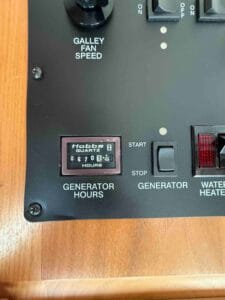
Understand your generator hours. On motorhomes, generator hours function as a second odometer and buyers absolutely look. If yours has sat, running it under load before a sale is worth doing — our post on getting better RV generator output walks through what actually helps.
Be honest about the private-sale path. Listing privately can net more on paper. It also means months of storage payments, tire-kickers, no-shows, test drives with strangers, and — in this market — a real chance the rig is worth less by the time it sells than when you listed it. That tradeoff was easy in 2021. It is a much closer call in 2026.
Older and higher-mileage rigs are their own category, and we cover them separately in selling an older RV for cash in Southern California.
What This Looks Like in Practice
The situations we see week to week track the data closely. A leaking trailer the owner had stopped using and did not want to repair. A trailer in El Segundo where the seller had lost the title and the paperwork entirely. A fifth wheel that other buyers had passed on because of its age.
None of those are ideal listings. All of them sold same-day for cash, because a direct buyer prices the rig as it sits rather than as it would need to be. You can read the full set on our customer reviews page — 167 reviews, all five stars, most of them from sellers in exactly these circumstances.
What to Expect Through the Rest of 2026
Two forces are pulling in opposite directions.
Pulling values down: financing costs remain elevated, household budgets are tight, and discretionary purchases keep getting deferred. Dealer inventory is still working through elevated levels on the towable side.
Providing a floor: manufacturers are cutting production hard. Fourteen percent fewer units shipped in six months eventually tightens supply. Class B and Class C demand has not broken. And the RV industry still represents $159 billion in annual economic impact, so the underlying interest in RV travel is intact.
The realistic read: production discipline should stabilize values sometime in 2027, but “stabilize” means stop falling — not recover to 2022 levels. If you are holding a rig you intend to keep using for another five years, none of this should change your plans. If you are holding one you have stopped using, every month of storage and depreciation is buying you a worse outcome.
Get a Same-Day Cash Offer
We are a family-owned buyer with over 20 years in the business, and we come to you. Motorhomes, travel trailers, fifth wheels, toy haulers, pop-ups — any make, any year, any condition, including rigs that do not run.
We handle the DMV paperwork and arrange pickup, usually within a few hours of your call. There is no listing, no storage bill running while you wait, and no obligation to accept.
We cover all of Southern California, including Los Angeles County, Orange County, Riverside County, San Bernardino County, San Diego County, and Ventura County. Our Mira Loma office serves the Inland Empire and our Van Nuys office covers the San Fernando Valley.
Call (562) 616-2636 or request your free cash offer online.
More market updates and selling guides are on our RV news and blog. Curious who you are dealing with? Read our story.
Frequently Asked Questions
Are used RV values going up or down in 2026?
Down. Black Book reported wholesale RV values continuing to ease through early 2026, with towables declining more sharply than motorhomes. Entry-level and older towable units have seen the most pressure.
Is 2026 a bad time to sell my RV?
It is a softer market than 2025, but waiting does not fix that. With RVIA’s own forecast revised down 8.2% for the year and no recovery expected until at least 2027, holding costs and continued depreciation generally outweigh any likely price improvement.
How much value does an RV lose per year?
Industry figures generally show 10–20% in the first year and roughly 36–38% by year five, though rates vary widely by class. Class A gas coaches depreciate fastest; Class B camper vans hold value best.
Can I sell an RV in California without the title?
Yes. A lost title is a routine situation and does not prevent a sale — the paperwork can be handled through the DMV as part of the transfer. We complete this for sellers regularly at no extra cost.
Do you buy RVs that do not run?
Yes. We buy motorhomes and trailers in any condition, including non-running units, water damage, and rigs that have been sitting for years.
How fast can I get paid?
Same day in most cases. You describe the RV, we make an offer, and we arrange payment and pickup — often within a few hours of the initial call.